Thank you for everything you’ve done. We were genuinely pleased with your work for the Buddha Center and would very much welcome your return as a teacher. Z.M.
In 2013, Demian Arbizu (later known as Damian Glendullen) discovered the Buddha Center in Sapphire Bay, founded by Zino March and Delani Gabardini. By that time, Damian had already written several Buddhist books and launched a website in 2011 focused on the Pali Canon, the earliest collection of Buddhist texts. After attending a few talks, Damian was drawn to the enthusiastic and diverse Buddhist community in Second Life. Recognizing his contributions as a published Buddhist author, the Buddha Center invited him to join their faculty, promoting his books through their bookstore, website, and Facebook page. From 2013 to 2015, Damian taught a popular weekly one-hour class, regularly attracting about a dozen participants.
As a sworn bodhisattva, Damian became a notable figure at the Center. He offered ten talks on the Pali Canon inspired by Bhikkhu Bodhi’s In the Buddha’s Words and conducted extensive series on the Digha Nikaya (34 talks) and Majjhima Nikaya (8 talks). He also explored a variety of topics, including the life of the Buddha, Buddhist cosmology, Angulimala, Taoism, and Buddhism’s intersection with the UFO phenomenon.
Over time, financial challenges caused the Buddha Center to decline. The group relocated from Sapphire Bay to a private sim, transitioning to silent meditation sessions with little dharma teaching. On the final day of the Buddha Center’s presence in Sapphire Bay, Damian ascended its highest point and vowed to revive the center as a teaching hub if the opportunity arose. Around this time, he adopted the name Seten Tomh, a variant of his Buddhist name reflecting his commitment to esoteric dharma. He published several works with Eonic Press, including Fundamental View, Conversations with the Buddha, Dharma Talks, The Good Path of Laozi (a Tao Te Ching translation), The Treasure House of Secrets, and a collection of Buddhist poetry.
After teaching dharma as a guest at various venues in Second Life, Seten retired to the OS Grid.
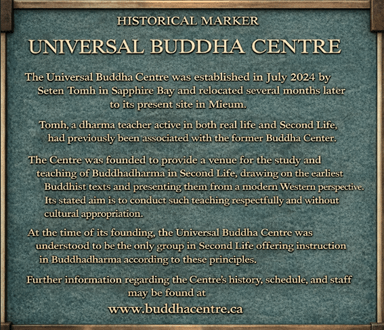
In July 2024, Seten experienced an urgent call to return to Second Life and investigate the Buddha Center’s status. He discovered the group had vanished, its lands vacant, and no activity on its Facebook page. Seten realized that the conditions of his vow had materialized. Their group profile was also gone and no one responded to our efforts to contact them on Facebook.
Without hesitation, he established a new Buddha Centre — a universal, non-sectarian, progressive dharma teaching hub. Renting the original land in Sapphire Bay at his own expense, Seten consecrated the centre on July 6, 2024, by reciting Vajrasattva’s 100-syllable mantra for four hours. He launched a new cycle of 108 teachings, optimized for oral presentation. After 14 months the first cycle is coming to a close and will be followed by a new cycle of dharma teachings.
Revised September 4, 2025.
Universal Buddhism
We hold that universal Buddhism is a comprehensive spiritual philosophy grounded in the intelligent study of sutta, sutra, Tantra, and terma, and the inspired teachings of devas, arhants, bodhisattvas, mahasiddhas, tertons, and buddhas across all times and cultures. Its core doctrines include existential suffering, impermanence, and selflessness (comprising the three characteristics of existence), buddha nature, wisdom, emptiness, interconnectedness, the path, skillful means, bodhicitta, compassion, moral causality, merit and its transfer, the Buddha, the teaching, and the order (comprising the three jewels), rebirth, gnosis, the meditative attainments, the power of truth, the two truths, the primordial tradition, the intermediate state, spiritual Brahmanism, and the Western transmission of the dharma. This encompasses metaphysics, ontology, cosmology, psychology, epistemology, logic, ethics, politics, aesthetics, and soteriology.
Universal Buddhism is a broad and inclusive spiritual path that brings together wisdom from all the major Buddhist traditions. Instead of following just one school of thought, it honours them all — seeing them as different expressions of the same deep truth. This approach draws on teachings from many countries, languages, and time periods, treating them not as fragments, but as parts of a single great tradition of awakening.
It’s rooted in the thoughtful study and practice of many kinds of sacred texts:
Suttas and sutras are the recorded teachings of the Buddha and other awakened beings — like spiritual talks or dialogues that guide us toward insight and freedom.
Tantras are advanced teachings, often symbolic or poetic, that help transform the mind and energy through powerful inner practices.
Termas are “hidden treasures” — teachings that were concealed in the past, meant to be rediscovered later when the world is ready.
Commentaries are writings by great thinkers and practitioners who help explain the meaning of earlier texts.
This tradition also respects the guidance of many kinds of enlightened beings and inspired teachers:
Devas are celestial or spiritual beings — not quite like gods, but higher, luminous beings who live in refined realms.
Arhants are those who have achieved full personal liberation and no longer suffer from the cycle of rebirth.
Bodhisattvas are beings of great compassion who vow to keep returning to help all others reach enlightenment.
Mahasiddhas are great yogis and mystics, often unconventional or wild in their behavior, who have achieved deep mastery over mind and reality.
Tertons are “treasure-revealers” who discover hidden teachings, often guided by visions or dreams.
And buddhas are fully awakened beings who understand reality directly and show the way to freedom.
Some of the main teachings and principles of Universal Buddhism include:
Wisdom — seeing clearly into the nature of life, beyond confusion or illusion.
Moral causality — the understanding that our actions have consequences, and that what we do shapes both our experience and the world around us. This is often called karma.
Interconnectedness — nothing exists independently; all things and beings are interwoven in a vast web of causes and conditions.
Merit — the spiritual energy or positive force created through good actions, generosity, meditation, or insight. A unique feature of Buddhism is that this merit can be transferred — that is, we can dedicate the good we’ve done to others. This might mean offering our spiritual blessings to help someone who is sick, struggling, or even deceased. It’s an expression of compassion: we practise not just for our own benefit, but for the welfare of all beings.
The power of truth — honest speech and living in alignment with truth is a real force that can cut through ignorance and bring healing.
Cosmology — a wide view of the universe that includes many layers of existence, from ordinary life to heavenly realms and deep states of meditation.
Meditative attainments — powerful states of mind achieved through deep concentration and insight, which bring clarity, peace, and liberation.
The primordial tradition — the idea that ultimate spiritual truth has always been present, and that true teachings can be found across time, cultures, and religions.
Spiritual Brahmanism — not a social caste system, but a recognition of ancient Indian roots of spiritual practice, especially the quest for liberation and union with the ultimate.
Gnosis — direct, personal, spiritual knowledge that comes from inner experience, not just from books or beliefs.
Rebirth — the understanding that life doesn’t end with death; our consciousness continues, shaped by our past actions and intentions.
Western transmission of the dharma — the way these ancient teachings are now being explored, adapted, and lived in the modern Western world — as part of a global awakening.
Universal Buddhism doesn’t limit itself to religious practice alone. It also speaks to deep questions about:
Metaphysics — What is reality, really?
Epistemology — How do we know what’s true?
Ethics — How should we live?
Politics — How can we build compassionate and just societies?
Aesthetics — What is beauty and meaning?
Logic — What makes a belief or argument valid?
Psychology — How does the mind work, and how can it be transformed?
Soteriology — How do we find liberation from suffering?
In short, Universal Buddhism is a wide-open, thoughtful, and compassionate approach to spiritual life. It bridges ancient and modern worlds, Eastern and Western cultures, mystical insight and everyday living. It’s about waking up — not just for ourselves, but for everyone — and finding a wiser, more loving way to be human.
Universal Buddhism is not a modern invention or a watered-down version of the tradition. It is a living, authentic lineage that draws directly from the original sources — the deep well of sacred texts, mystical experience, disciplined practice, and enlightened transmission. It honours the full depth of the Buddha’s teaching, including its ethical, meditative, philosophical, mystical, and cosmological dimensions. It does not cherry-pick, flatten, or sanitize the dharma to make it more palatable for consumer culture.
By contrast, secular Buddhism strips away the spiritual core — denying rebirth, rejecting karma, dismissing unseen realms and inner transformation, and treating the Buddha as little more than a self-help coach. While it may offer useful techniques for stress relief or mental clarity, it distorts the dharma by cutting it off from its own roots. It replaces awakening with comfort, and transcendence with utility. In doing so, it misleads people into believing that Buddhism is just another lifestyle brand — safe, marketable, and spiritually shallow.
Universal Buddhism keeps the flame alive — not as nostalgia, but as a conscious commitment to depth, truth, and liberation for all beings. It holds that the dharma is not just relevant but urgent — not just true for the past, but necessary for the future.
Questions & answers
What is the “Universal Buddha”?
The Universal Buddha is not a single historical person, but a principle. In Buddhist thought, the term points to Buddhahood as a universal reality rather than an individual achievement. Put simply:
The Universal Buddha is awakening itself, present everywhere, at all times, and in all beings.
A few ways the idea is used across traditions:
1. Buddha as cosmic principle
In Mahāyāna Buddhism, especially in texts like the Avataṃsaka Sūtra, Buddhahood is understood as coextensive with reality itself. The Buddha is not merely someone who has enlightenment, but the expression of the enlightened nature of the cosmos. This is sometimes called:
- Dharmakāya (Dharma-body)
- Buddha as suchness (tathatā)
- Buddha as the ground of being
Here, “Universal Buddha” means the awakened nature of reality as such.
2. Buddha-nature (Tathāgatagarbha)
In another register, the Universal Buddha refers to Buddha-nature present in all sentient beings. This does not mean everyone is already a Buddha in the ordinary sense, but that:
- the capacity for awakening is universal
- awakening is uncovered, not manufactured
So the Universal Buddha is immanent, not remote.
3. Timeless Buddha vs historical Buddha
Historically, Śākyamuni is a Buddha.
But the Universal Buddha is what makes any Buddha possible. A common formulation:
- Śākyamuni = a manifestation
- Universal Buddha = the principle that manifests through him
In this sense, Buddhas are expressions, not exceptions.
4. Dzogchen and non-dual readings
In Dzogchen and related non-dual traditions, the Universal Buddha is essentially:
- primordial awareness
- rigpa
- the already-present awakened condition
Nothing needs to be added. Only recognition is missing. In one sentence
The Universal Buddha is awakening understood as universal, timeless, and intrinsic to reality and all beings—rather than confined to one man, one era, or one culture.
It’s the difference between saying:
“The Buddha was enlightened”
and saying:
“Enlightenment is what reality is doing, everywhere.”
What is the relationship between the Buddha Center and the Universal Buddha Centre?
At the time that the Buddha Centre was established there was no evidence of any activity by the Buddha Center in Second Life. As stated above, the group’s lands were vacant, their group name was not searchable in Second Life, and their Facebook group was inactive and unresponsive to questions (it now appears to have been deleted). In response to this situation, Seten Tomh was encouraged by several members of the former Buddha Center to create a new group, based on the Canadian spelling (our headquarters are in Toronto, Canada). “Buddha Centre” is a legitimate group in Second Life, properly registered as such by Linden Labs in accordance with its terms of service. For the record, the Universal Buddha Centre does not claim to be the same organization as the Buddha Center, and never has. It was only after the Buddha Centre was registered and established a virtual presence in Second Life, at significant personal expense, that the Buddha Center reappeared as a public group in Search. However, the name “Buddha Center” is generic and is not an original or copyrightable name, millions of iterations of which exist online as can be confirmed by a simple Google search. This has also been confirmed by legal research. Moreover, the name “Buddha Center” now appears to be used by a number of different groups in Second Life, mostly associated with the occasional practice of so-called “silent meditation.”
Significantly, almost all of the original teachers associated with the Buddha Center have disappeared.
“The Universal Buddha Centre” is currently engaged in authentic dharma teaching based on traditional Buddhist texts, and will continue to do so.
Is secular Buddhism real or authentic Buddhism?
Secular Buddhism is not traditional Buddhism. Secular Buddhism is a modern Western interpretation of the Buddha’s teachings that:
- Rejects metaphysical claims (rebirth, karma-as-cosmic-law, devas, hell realms).
- Emphasizes mindfulness, ethics, and insight into suffering and impermanence.
- Treats the Buddha as a philosopher or human teacher, not a supernatural being.
- Often strips away rituals, cosmology, and devotional elements.
Its leading figures include:
- Stephen Batchelor
- Winton Higgins
- Martine Batchelor
Traditional Buddhism, across Theravāda, Mahāyāna, and Vajrayāna, holds that:
- Rebirth and karma are real and essential.
- Enlightenment involves transcending samsāra across lifetimes.
- The Dharma includes ritual, cosmology, monasticism, and devotional practices.
- The Buddha had supramundane knowledge and taught the path to liberation beyond death.
In this view, secular Buddhism looks like a selective cultural appropriation of the Dharma, and is not really Buddhism at all, and is really anti-Buddhist.
So—Is It Authentic?
- Historically? No. It departs from the core assumptions of all classical schools.
- Philosophically? Questionable. It misses the deeper metaphysics and transformational arc of the original path.
Final Word
Secular Buddhism is a modern innovation, not traditional or canonical. It can serve as a gateway or entry point, but to call it “Buddhism” in the traditional sense is, frankly, a stretch. It may be more accurate to say it is Buddhist-inspired mindfulness philosophy.
Who is Seten Tomh?
Seten Tomh is a contemporary Canadian writer, poet, and spiritual thinker whose work bridges mysticism, esotericism, and contemplative philosophy. His writings often explore the intersections of Buddhist, Taoist, and other traditions, delving into themes of transcendence, suffering, and spiritual awakening.
Notable Works by Seten Tomh
Buddhist Writings
- Fundamental View (2013)
A rigorous yet accessible exposition of the core principles of Dharma, this book presents Tomh’s interpretation of the view (ditthi) that underlies all Buddhist practice. Integrating insights from early Pāli sources and later Mahāyāna perspectives, it offers a contemporary rendering of the Buddha’s liberating vision. - Conversations with the Buddha (2015)
A modern-day philosophical dialogue inspired by the Sutta style, blending wit, clarity, and fierce honesty. The Buddha here appears not as a remote figure of the past, but as a living voice speaking directly to our modern dilemmas. - Dharma Talks (2012)
A collection of transcribed public talks and private reflections offering practical, unvarnished guidance for lay practitioners. The tone is direct and vernacular, rooted in daily life and aimed at cutting through illusion. - The Treasure House of Secrets (2017)
A meditative and poetic rendering of Buddhist wisdom teachings, structured as a contemplative text. Combining the cadence of scripture with the soul of a poet, Tomh reveals the hidden richness of the Dharma through layered metaphor and spiritual insight.
Poetry and Esoteric Writings
- Selected Poems of Seten Tomh (2024)
A wide-ranging anthology interweaving Buddhist, Taoist, and other themes. The poems serve as meditative koans, spiritual cartography, and aesthetic testimony to the pathless path. - UR Poems (2021)
A visceral and haunting sequence of poems confronting time, rage, silence, and the sacred. This work marks a spiritual-political rebellion expressed through language that disrupts and liberates. - Ardhe 42 (2022)
A cryptic, visionary work exploring postmodern mysticism. It combines aphorism, surrealism, and occult imagery to chart a path through spiritual desolation toward transfigured awareness. - The Chiselled Garden (2024)
Poetry as dharma art. This collection cultivates clarity and emptiness with a sculptor’s precision and a monk’s heart, drawing the reader into deep stillness and sudden illumination.
Other Works
- The Good Path of Laozi (2019)
A complete and original translation of the Tao Te Ching, rendered in spare, meditative English. Tomh presents Laozi’s verses as a direct transmission of the Tao’s wisdom—unadorned, contemplative, and resonant with Buddhist sensibilities. This work invites deep reading and silence, offering the Tao not as philosophy but as living path.
Themes and Style
Tomh’s writing is characterized by a fusion of poetic lyricism and philosophical depth. His works often challenge readers to confront existential questions and embrace the complexities of the human condition. Drawing from various spiritual traditions, he offers a unique perspective that is both introspective and expansive.
Tomh’s books are available for purchase at Eonic Press.

Continuity
In Sapphire Bay, where water dreams,
A seeker walked beneath the moon.
His books already spoke the streams
Of dharma’s voice, both fierce and soon.
He climbed the steps, he taught the way,
Ten talks became a shining tide—
Digha’s length and Majjhima’s ray,
The Buddha’s life, the stars allied.
But tides recede, and silence came;
The halls grew still, the voices thinned.
Yet on the highest point he claimed
A vow: to call the wind again.
Years like rivers turned and turned,
Until the call came, clear as fire:
The land lay empty, banners burned—
The vow awoke its old desire.
He took a name of secret sound,
Seten Tomh, the vow made flesh.
He called the mantras, held the ground,
And lit the teaching’s flame afresh.
Now Sapphire’s shore has breath anew,
A Centre stands, both wide and free;
Its roots are deep, its sky is true,
Its voice a bridge across the sea.
Universal, not confined—
It gathers sutra, terma, song.
Across the centuries intertwined,
The dharma’s thread is ever strong.
 The Universal Buddha Centre